
Artificial Lift Systems in Oil & Gas: An Overview of Technologies, Applications, and Selection Criteria
· By Diego Cordova
A structured overview of the most widely used artificial lift technologies, from rod pumps to ESPs and gas lift: how each works, where it fits, and what to weigh when choosing one.
Introduction
Oil and gas production is a technically demanding process that requires sophisticated equipment and operational strategy. One of the most critical components is the artificial lift system, designed to enhance fluid flow from the reservoir to the surface once natural pressure is no longer sufficient.
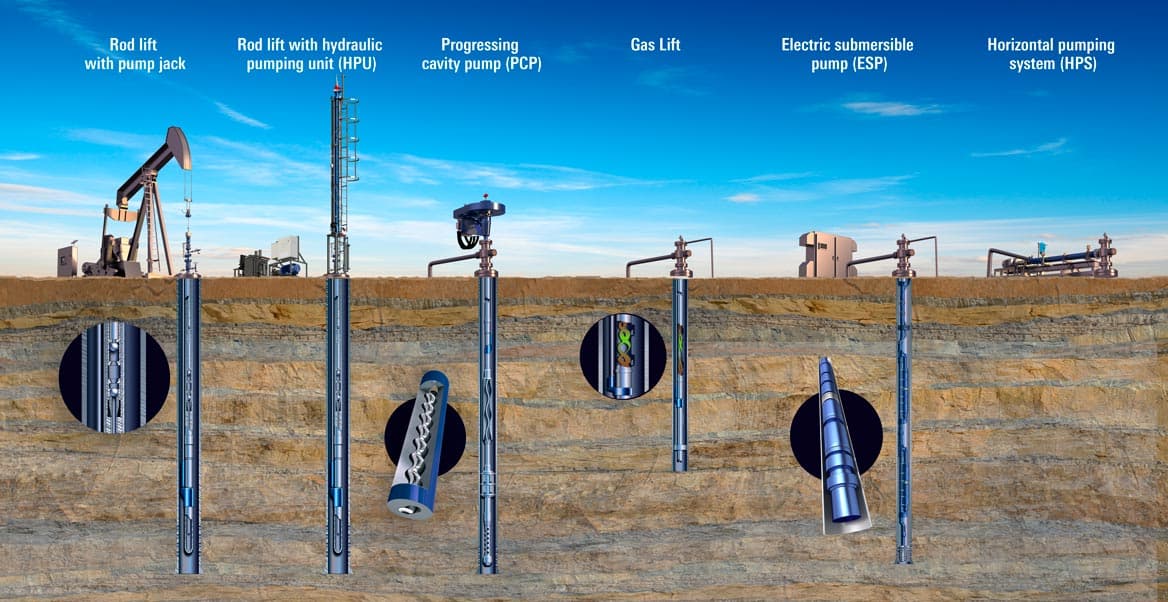
From traditional rod pumps to advanced electric submersible pumps and gas lift technologies, each system has unique advantages and trade-offs. This article provides a structured overview of the most widely used artificial lift technologies, their operating principles, field applications, and key considerations to guide system selection.
The Need for Artificial Lift Systems
Over time, reservoir pressure naturally declines, reducing a well’s ability to flow hydrocarbons unaided. When pressure falls below the minimum required to lift fluids to surface, artificial lift systems become essential. Key influencing factors include:
- Well depth
- Reservoir pressure and permeability
- Fluid viscosity and GOR (gas-oil ratio)
- Water cut and solids content
Artificial lift improves recovery, stabilizes production, and can extend the economic life of wells.
Comparison of Artificial Lift Systems
| System | Best Suited For | Max Depth (ft) | Sand Tolerance | GOR Tolerance | Flow Rate Range (BOPD) | CAPEX | OPEX |
|---|---|---|---|---|---|---|---|
| Rod Pump | Onshore, shallow to medium wells | ~12,000 | Moderate | Low to moderate | 50 – 2,000 | Low | Low |
| Gas Lift | Deep wells, high GOR | >15,000 | High | Very high | 500 – 20,000+ | Medium | Medium |
| ESP | High-volume producers, offshore, deviated | ~15,000+ | Low to moderate | Moderate | 1,000 – 50,000+ | High | High |
| PCP | Heavy oil, high solids or GOR | ~6,000–8,000 | High | High | 100 – 5,000 | Medium | Medium |
| Hydraulic Jet Pump | Slim wells, high GOR or solids | ~15,000 | High | High | 100 – 4,000 | Medium | High |
Rod Pump Systems
Operating Principle
Rod pump systems (also called beam pumps) use a surface unit to drive a sucker rod string that reciprocates a downhole piston pump.
Advantages
- Simple and widely available
- Proven and well-understood
- Works well in shallow to medium-depth wells
- Inexpensive and low-maintenance
Limitations
- Less effective in deviated or deep wells
- Poor performance under high GOR or high sand
- Limited to moderate flow rates
Gas Lift Systems
Operating Principle
Gas is injected into the tubing, reducing the fluid column density and allowing reservoir pressure to push fluids to surface. Two modes exist:
- Continuous gas lift
- Intermittent gas lift
Advantages
- Excellent for high-GOR and deep wells
- Works with deviated or horizontal wells
- Can produce intermittently without rod wear
- Fast restart after shut-in
Limitations
- Requires infrastructure for gas injection
- Sensitive to changes in gas availability or quality
- Higher technical complexity
Electric Submersible Pumps (ESP)
Operating Principle
A downhole electric motor powers a multistage centrifugal pump to lift large volumes of fluid through production tubing.
Advantages
- High production rates (up to 50,000+ BOPD)
- Suitable for offshore or space-constrained environments
- Can be deployed in deviated wells
Limitations
- High CAPEX and energy consumption
- Limited sand tolerance
- Requires VFDs and surface control systems
- Failure often requires a rig for replacement
Progressive Cavity Pumps (PCP)
Operating Principle
A helical rotor turns inside an elastomeric stator, creating cavities that move fluid upward with each rotation.
Advantages
- Excellent for viscous and multiphase fluids
- High solids handling
- Simple downhole equipment with strong volumetric efficiency
Limitations
- Elastomers degrade with high temperature and certain chemicals
- Not suitable for deep wells
- Motor-driven PCPs (ESPCPs) require more complex completions
Hydraulic Jet Pumps
Operating Principle
Uses high-pressure power fluid to entrain well fluids through a nozzle-venturi mechanism, creating lift.
Advantages
- No downhole moving parts
- High sand and GOR tolerance
- Excellent for deviated or slimhole wells
Limitations
- Low energy efficiency
- High OPEX due to power fluid recirculation
- Requires careful design and maintenance
Key Selection Considerations
| Factor | Most Suitable System(s) |
|---|---|
| High GOR | Gas Lift, Jet Pump, PCP |
| High Sand/Viscosity | PCP, Jet Pump |
| Very High Production | ESP, Gas Lift |
| Slimhole/Deviated | ESP, Gas Lift, Jet Pump |
| Low OPEX Required | Rod Pump, PCP |
| Remote/Offshore | ESP, ESPCP, Gas Lift |
| High-Temp Environments | ESP (HT models), Metal PCP, Jet Pump |
A proper selection must consider reservoir behavior, decline rate, fluid properties, and total lifecycle costs. Pilot tests or simulation-based lift evaluations can also guide decision-making.
Conclusion: Choosing the Right Lift System
Artificial lift is not a one-size-fits-all solution. The optimal system depends on technical parameters, economic goals, and field development strategy. While rod pumps are cost-effective and simple, ESP systems offer unmatched volume capacity, and gas lift excels in high-GOR and deep settings.
Operators should:
- Assess reservoir and well conditions thoroughly
- Run nodal analysis or artificial lift simulations
- Weigh CAPEX vs OPEX over time
- Work with lift specialists to adapt systems as wells evolve
Choosing the right artificial lift system is essential for maximizing recovery, maintaining uptime, and minimizing long-term costs.